





Introduction
1.1 Setting the Tone: Why Music Matters in Final Farewells
Music speaks when words fall short, offering comfort, continuity, and a sense of togetherness during moments of grief. It transcends language, culture, and faith, serving as a bridge between the living and the memories of those who have passed on. Whether played softly in the background or performed by a choir, the right piece of music can convey emotions too deep for verbal expression.
Across life’s milestones, such as births, weddings, celebrations, and farewells, music stands as a faithful companion. In a funeral setting, it shapes the atmosphere, transforming sorrow into reflection, silence into solace, and remembrance into quiet celebration. A single melody can bring comfort to the bereaved, evoke cherished memories, or provide strength to face the days ahead.
In Singapore, where diverse faiths and traditions coexist, the role of funeral music continues to evolve. While hymns and religious chants remain deeply meaningful, more families today are incorporating modern and personalised pieces. These include favourite songs, instrumental tracks, or compositions that capture their loved one’s character and journey, turning a farewell into something profoundly personal and healing.
This guide explores how funeral music has transformed across time and culture. It will delve into its historical roots, religious and cultural influences, psychological and emotional effects, and practical considerations for families planning heartfelt and meaningful funeral services.
Key Takeaways
- Music plays a timeless role in farewells, guiding mourners through moments of reflection, remembrance, and peace. It offers comfort and gives voice to emotions that words alone cannot fully express.
- Across faiths and cultures, musical traditions continue to evolve, blending sacred hymns, chants, and modern melodies into deeply personal tributes that honour each life in its own way.
- Beyond its ceremonial role, music also nurtures emotional healing, helping individuals process grief and connect through shared memories. The right melody can evoke calm, gratitude, and even hope in moments of sorrow.
- Ultimately, choosing meaningful music transforms a funeral into a lasting celebration of life, one that balances tradition and individuality, bringing solace to families and unity among all who gather to remember.
Part 2: Music as a Pillar of Funeral Traditions

2.1. The Historical Role of Music in Funeral Services
From the earliest civilisations to the present day, funeral music has remained a faithful companion in humanity’s expression of grief and remembrance. It has long held a sacred place in farewell rituals, transcending geography, belief systems, and time itself.
In ancient Greece, mourners sang laments to honour the deceased, while tribal communities used rhythmic drumming to symbolise the spirit’s passage into another realm. Similarly, in Buddhist traditions, chants and gongs have long been used to guide the soul’s journey toward enlightenment and peace. Each of these sounds carried both spiritual significance and emotional depth, offering structure to mourning and comfort to those left behind.
During early Christian and Catholic funerals, psalms, Gregorian chants, and organ hymns created solemn, reverent atmospheres. These musical elements, often performed within candle-lit chapels or cathedrals, still inspire religious services today and remain foundational to many religious funeral rites.
Across all these cultures, funeral music is more than a mere performance. It is a universal language of loss and hope. It gives voice to what cannot be spoken, helping the bereaved process emotions and preserve memory. In Singapore’s multicultural society, this diversity is beautifully reflected in the range of musical traditions observed in Christian, Buddhist, Taoist, Catholic, and free-thinker ceremonies. Together, they form a vivid tapestry of how funeral music continues to shape humanity’s most profound farewells.
2.2. Hymns and Religious Music: Anchoring Tradition
Religious funeral music remains one of the most enduring ways to express faith, devotion, and gratitude. For centuries, hymns and chants have provided structure, solace, and a shared sense of understanding within funeral ceremonies, grounding each service in the familiar sounds of worship.
In Christian funerals services, hymns such as Amazing Grace and Abide With Me continue to be sung across generations. Their melodies evoke comfort, peace, and the assurance of eternal rest. When accompanied by gentle organ preludes or choir harmonies, these timeless pieces help mourners find calm amid sorrow.
Catholic funeral services in Singapore often include sacred pieces such as Ave Maria, responsorial psalms, and choral Mass settings that mirror the rhythm of prayer and reflection. These compositions bring a sense of reverence and continuity, linking individual loss with the broader faith community.
In Buddhist funeral services in Singapore, the chanting of sutras and mantras guides the spirit through the cycle of rebirth, while the rhythmic sound of bells and wooden fish drums encourages mindfulness and compassion among attendees.
Taoist funeral services feature Daoshi-led chants accompanied by ritual percussion and flute melodies, which symbolise the soul’s safe passage and the family’s respect for ancestral lineage.
Meanwhile, in non-religious settings where there is no prescribed framework, funeral music often becomes the heart of the ceremony. Families may select classical symphonies, modern ballads, or the departed’s personal favourites, songs that embody who they were and what they loved. In these moments, music transforms from ritual to remembrance, celebrating individuality rather than doctrine.
Understanding how each faith and philosophy incorporates funeral music allows families to create services that feel deeply personal yet culturally rooted. This awareness empowers them to honour their loved one’s beliefs while offering solace and unity to every mourner present.
2.3. Contemporary Choices: Music for the Individual
As society changes, so have the ways we say goodbye. In Singapore, modern funerals are increasingly evolving from purely ritualistic occasions into intimate celebrations of life that reflect each person’s unique character, passions, and journey.
Personalised selections of funeral music now play a central role in shaping these heartfelt farewells. Families often choose funeral songs that capture their loved one’s personality, music that feels less about death and more about life, connection, and continuity. Popular modern pieces such as Time to Say Goodbye by Andrea Bocelli or Somewhere Over the Rainbow by Israel Kamakawiwo’ole are often chosen for their ability to balance sorrow with serenity and loss with hope.
Younger generations are embracing blended approaches that combine traditional funeral hymns with contemporary songs or instrumental arrangements. It’s not uncommon for ceremonies in Singapore to include both a sacred chant and a beloved pop ballad, showing how personal stories can harmonise with age-old customs.
Funeral directors now work closely with families to harmonise these choices, ensuring that every musical element aligns with cultural expectations, religious practices, and the desired emotional tone. This thoughtful balance allows services to remain respectful while authentically representing the life being honoured.
Ultimately, funeral music today is about connection, to faith, to memory, and to one another. It transforms grief into gratitude and reminds the living that even in silence, the melodies of love continue to play.
Part 3: The Modern Significance of Funeral Music
3.1. The Psychological Impact of Music on Grief
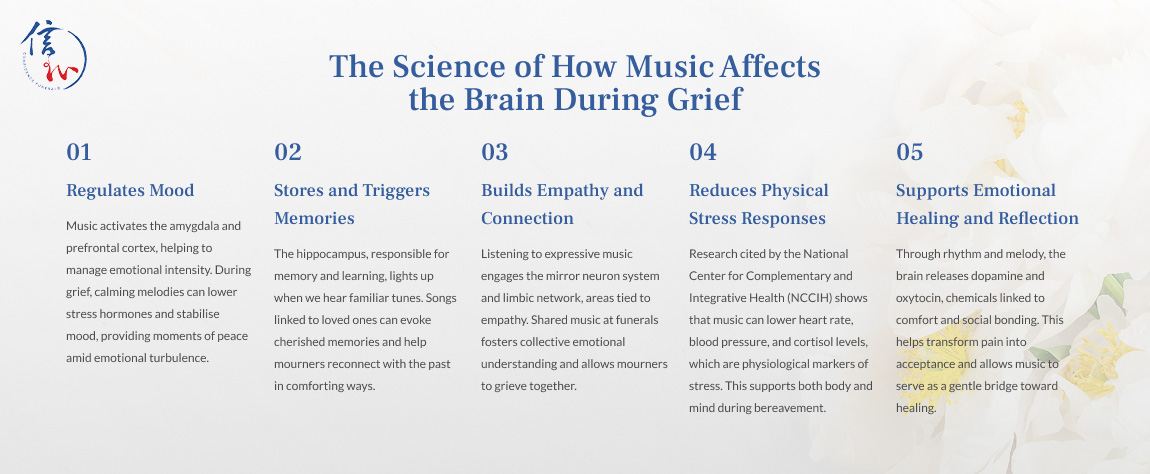
Silence can often feel overwhelming in the midst of loss. In these quiet spaces, emotions may remain unspoken, leaving mourners searching for ways to release their pain and find peace in remembrance. This is precisely where funeral music plays a profound psychological role, bridging the emotional gap between sorrow and solace. It helps individuals navigate the complex process of grief, making the relationship between grief and music a gentle companion in the healing journey.
Research in psychology and music therapy has shown that music can regulate mood, reduce stress, and stimulate parts of the brain linked to memory and empathy. According to the National Center for Complementary and Integrative Health (NCCIH), listening to or performing music activates several brain regions involved in emotion and cognition, thereby supporting both psychological well-being and emotional connection. Certain melodies can awaken vivid recollections, connecting mourners with shared experiences and comforting them through collective remembrance. Even a few familiar notes can trigger a sense of presence that reminds families of their loved one’s laughter, voice, or cherished moments.
At national memorials, solemn compositions such as The Last Post performed at military funerals embody this deep emotional resonance. They serve as powerful symbols of respect, unity, and closure. Similarly, families in Singapore are increasingly curating music that reflects calm, hope, or gratitude, transforming funeral music from a traditional formality into a therapeutic expression of healing, remembrance, and love.
3.2. Choosing the Right Funeral Music
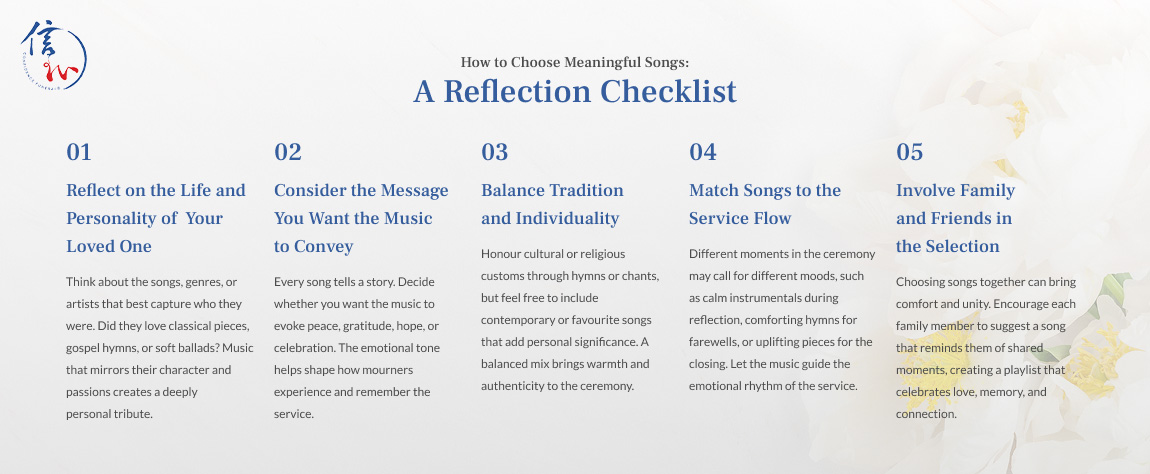
Selecting funeral music can feel daunting, especially when families are coping with both emotional strain and logistical decisions. Yet, this process often becomes a meaningful act of love, an opportunity to reflect on what the departed cherished and how they would wish to be remembered.
The most important consideration is meaning. Rather than focusing solely on popularity or tradition, families are encouraged to choose songs that carry emotional or symbolic significance. Religious and cultural customs may guide the overall structure—for instance, hymns for Christian ceremonies or chanting for Buddhist services, while personal favourites help to make the occasion more heartfelt and personal.
Funeral music can also be thoughtfully arranged throughout different moments of the service. The entrance procession might feature an uplifting hymn or instrumental prelude. During reflection or eulogy, a slower, contemplative piece may provide comfort, and at the final committal, a hopeful melody can symbolise farewell and continuity.
Families can decide whether to have a live performance by a choir, soloist, or musician, or to use recorded pieces for consistency. Venue acoustics also play a key role, whether the service is held in a church, temple, funeral parlour, or crematorium. Funeral directors are often well-equipped to assist in playlist curation, music arrangement, and coordination, ensuring that every note complements the ceremony’s tone and purpose. With compassionate guidance, funeral music becomes more than just a background sound; it becomes the emotional heartbeat of the farewell. Thoughtful music for funerals in Singapore reflects both cultural diversity and personal expression, helping families find comfort and meaning through each chosen piece.
3.3. Balancing Tradition with Modernity in Singapore
In Singapore’s multicultural landscape, funeral practices reflect a rich tapestry of beliefs, values, and generational perspectives. The choice of funeral music often sits at the heart of this balance between preserving tradition and embracing individuality.
Older generations often find comfort in the familiarity of religious hymns and ceremonial chants, sounds that carry deep spiritual meaning. Younger family members, by contrast, may prefer contemporary or instrumental pieces that evoke personal memories. Rather than viewing these preferences as opposing forces, families can weave them together into a unified and harmonious tribute.
For instance, a ceremony might begin with a traditional hymn such as How Great Thou Art or Amazing Grace, followed by a modern instrumental or a gentle classical piece that symbolises continuity and peace. Some families also blend sacred elements such as Buddhist mantras or Taoist flute music with ambient or orchestral arrangements, creating a hybrid soundscape that feels both timeless and deeply personal.
This blending of old and new mirrors Singapore’s evolving approach to remembrance, one that honours faith, respects diversity, and celebrates individuality. Through this harmony, funeral music becomes a universal connector, offering comfort not only to those who share the same beliefs but to all who come together in collective remembrance.
Conclusion
Music carries meaning that extends far beyond melody or rhythm. It is an expression of love, remembrance, and unity, a language that speaks to the heart when words cannot. Whether solemn or uplifting, familiar or new, funeral music has the power to soothe grief, honour a life lived, and celebrate the enduring bonds that remain.
From sacred hymns that reflect faith and continuity to personal favourites that capture cherished memories, each choice of funeral music builds a bridge between tradition and individuality. These melodies remind us that while loss is deeply personal, remembrance can also be shared, bringing family and friends together in reflection and peace.
In Singapore’s multicultural setting, this balance between heritage and personal expression becomes even more meaningful. Music helps weave together diverse beliefs and generations, allowing families to create services that are both respectful of tradition and deeply true to their loved one’s identity.
Every farewell deserves to be meaningful, and every family deserves the space to choose what feels right. At Confidence Funeral Services Pte Ltd, we understand the importance of these decisions. Our compassionate team is here to guide you through each step, from traditional hymns to contemporary selections, helping you craft a service that brings comfort, remembrance, and dignity to your loved one’s final tribute.
Contact us today to explore how thoughtful funeral music can bring healing and harmony to your farewell ceremony.
Questions You Might Have
1. Can I play non-religious music at a religious funeral?
Yes, though it depends on the faith, venue, and the officiant’s guidelines. Some churches, temples, or halls in Singapore allow a respectful balance between sacred and secular pieces. For example, a service might open with a hymn or chant and close with a favourite non-religious song that holds personal meaning. It’s always best to consult your officiant or your funeral director at Confidence Funeral Services Pte Ltd, who can guide you in ensuring your choices remain both meaningful and respectful to the ceremony’s setting.
2. What music is suitable for a Free-thinker funeral?
A free-thinker funeral often focuses on individuality, reflection, and the celebration of life rather than formal religious rites. Music becomes the emotional centre of the ceremony, offering families complete freedom of choice. Classical pieces, jazz, instrumental works, or even contemporary songs can be used to express love and memory. Some families create playlists of their loved one’s favourite tracks, turning the farewell into a deeply personal reflection of their personality, passions, and life story.
3. How many songs should I prepare for a funeral service?
There is no fixed number of songs required for a funeral, but most services include music at several key moments to guide the flow of the ceremony. Typically, a piece is played at the beginning as guests enter, followed by one or two selections during the reflection or eulogy segment. Another song may accompany the final committal or farewell, with a closing piece marking the recessional as attendees leave. Depending on the structure and length of the service, this usually amounts to three to five pieces of funeral music, each thoughtfully chosen to reflect the emotions of the ceremony, from solemn reflection to gentle closure.
4. Is live music better than recorded music at funerals?
Both live and recorded music can create meaningful experiences, depending on your preferences, budget, and venue. Live performances by choirs, instrumentalists, or family members add intimacy and emotional resonance, while recorded tracks offer precision and familiarity. Many families in Singapore blend both options; for example, they may begin with a live hymn and conclude with a recorded song that holds personal significance. At Confidence Funeral Services Pte Ltd, funeral directors can help advise on acoustics, equipment, and performance arrangements to ensure each moment flows seamlessly.
5. Can family members perform music during the service?
Yes, and it can be one of the most moving gestures during a farewell. A sibling singing a hymn, a child playing an instrument, or a friend performing a meaningful song can create an atmosphere of authenticity and love. However, it’s important that the performer feels emotionally prepared and comfortable, as these moments can be deeply moving. Funeral coordinators can help rehearse timing, manage setup, and ensure the music integrates naturally into the flow of the ceremony.